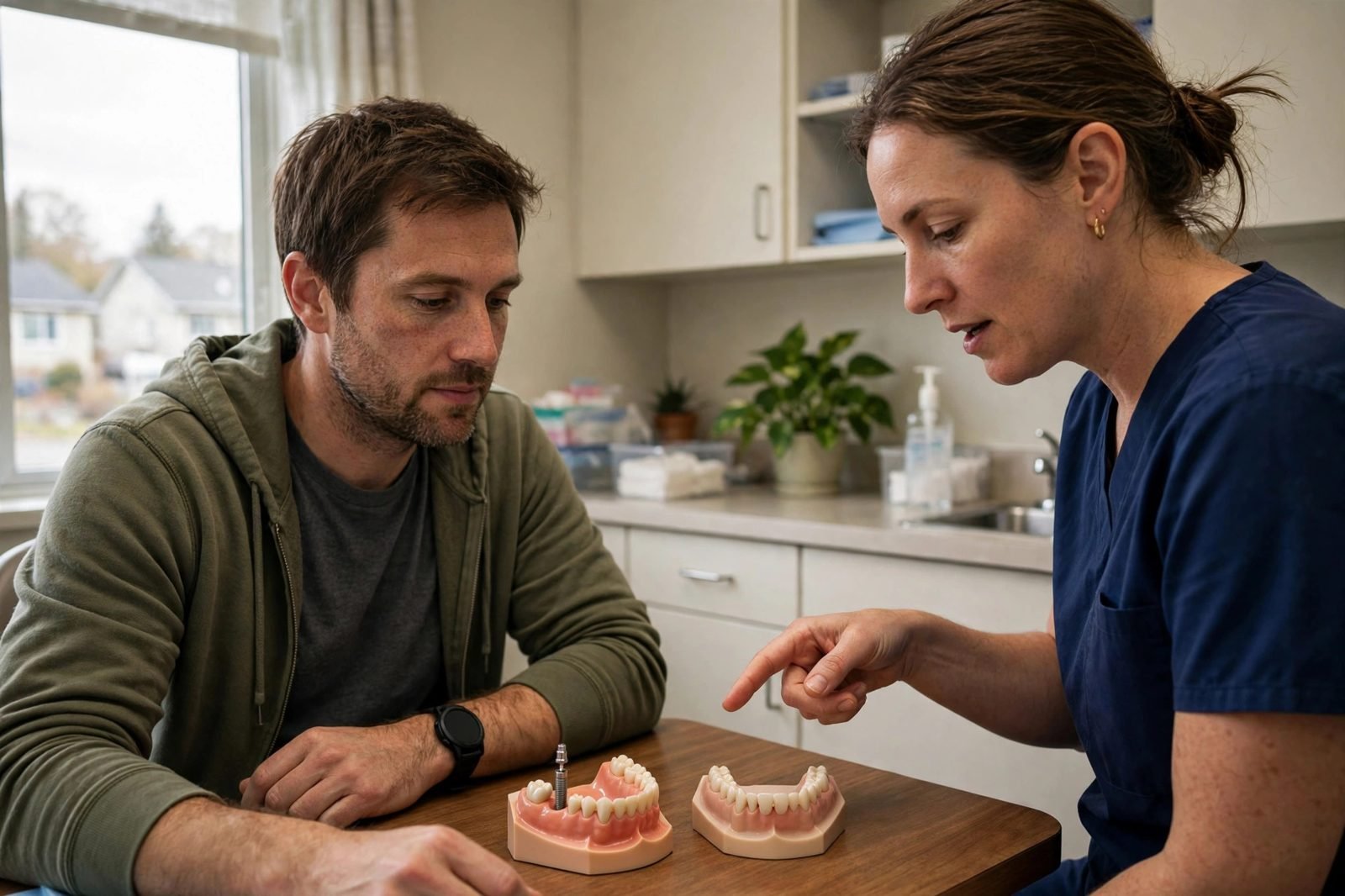
Choosing between a dental implant vs fixed bridge in Bradford is the decision most patients face after losing a single tooth. Both replace the visible tooth. They differ in what happens under the gum, what happens to the neighbouring teeth, and what care looks like over the years. This guide compares them honestly, including who each option does not suit, so you can arrive at your assessment at Hola Dentistry already knowing the right questions to ask. For the full picture of the implant option itself, see our page on dental implants in Bradford.
What each option is
A dental implant is a small titanium post placed in the jawbone where the tooth root used to be. After the bone bonds to it, a crown is attached on top. It stands on its own and does not touch the neighbouring teeth. A fixed bridge is a set of joined crowns: the teeth on either side of the gap are shaped down, and a false tooth suspended between two crowns is cemented over them. The bridge depends on those neighbouring teeth for support.
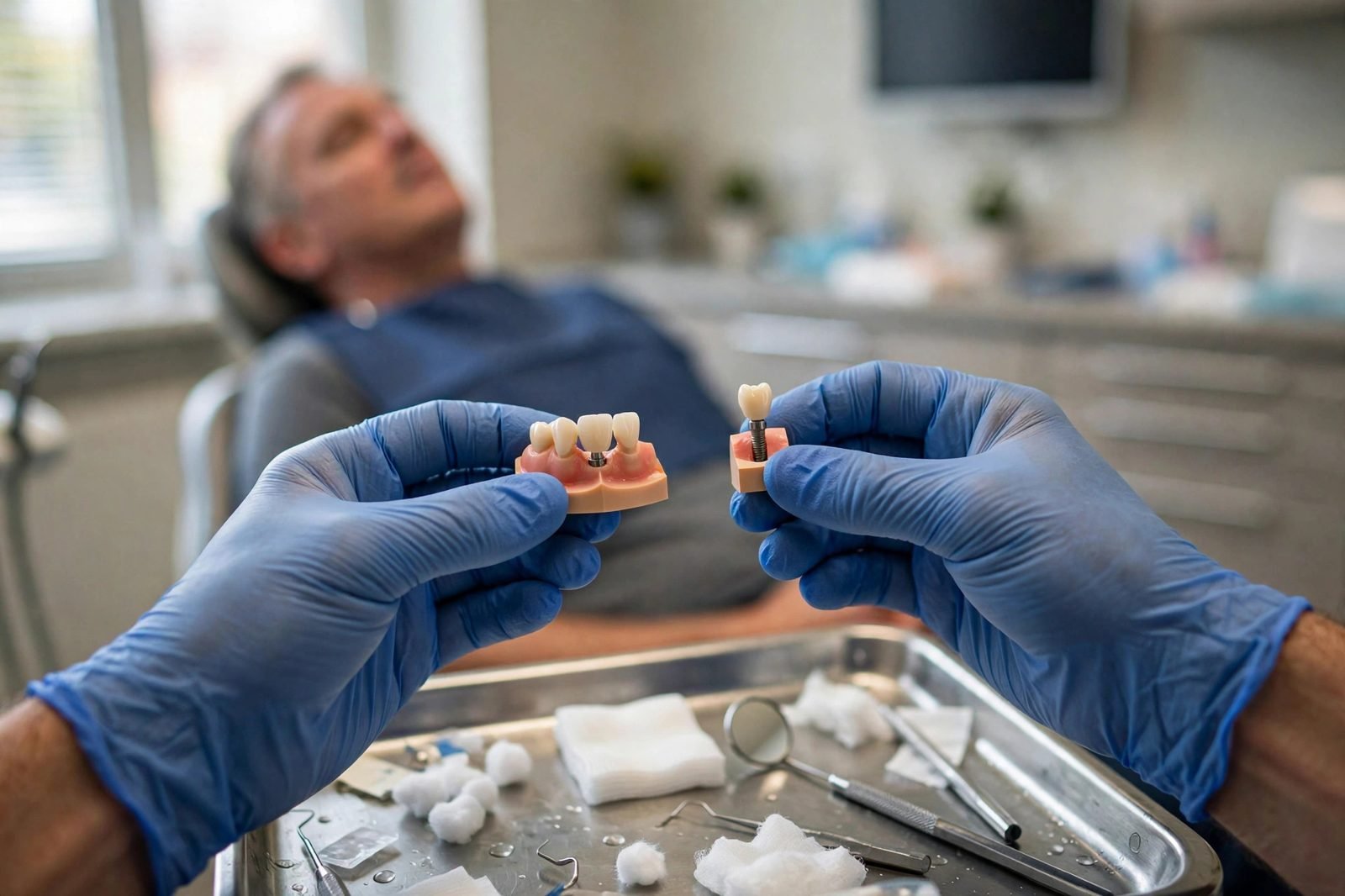
Side-by-side comparison: dental implant vs fixed bridge
| Question | Dental implant | Fixed bridge |
|---|---|---|
| What it is / how it works | A titanium post in the jawbone acts as an artificial root; a single crown is attached to it. | Joined crowns cemented onto the two neighbouring teeth, with a false tooth filling the gap between them. |
| Typical lifespan | Systematic reviews by Pjetursson and colleagues (Clinical Oral Implants Research) report that roughly 9 in 10 single implants — measured as the implant still in place and supporting a crown — remain in function at 10 years. Individual results vary with health, bone and care. | The same body of systematic reviews reports roughly 9 in 10 tooth-supported fixed bridges still in place at 10 years, measured as the bridge not needing replacement. A bridge’s life is tied to the health of its supporting teeth. |
| Maintenance and care | Brush and clean around it like a natural tooth, with attention to the gumline; regular checkups and cleanings. | Daily cleaning under the false tooth with floss threaders or interdental brushes is essential; the supporting teeth need the same care as any crowned tooth. |
| Effect on neighbouring teeth and jawbone | Neighbouring teeth are left untouched. The implant loads the jawbone where the root was lost, which helps maintain bone in that spot. | Both neighbouring teeth must be shaped to hold crowns, even if they are healthy. The bone under the gap receives no root-like loading and tends to shrink slowly over time. |
| Who it suits and who it does not | Suits patients with enough healthy jawbone and gums who want a stand-alone replacement. It may not suit people with uncontrolled medical conditions, heavy smokers unwilling to pause, or too little bone without grafting — an assessment decides. | Suits patients who need a faster, non-surgical replacement, or whose neighbouring teeth already need crowns. It is a poorer fit when the neighbouring teeth are healthy and untouched, because they must be cut down to support it. |
| Number of visits and timeline | Several visits over a few months: placement, a healing period while bone bonds to the post, then the final crown. | Usually two to three visits over a few weeks: preparation and impressions, then fitting of the finished bridge. |
| CDCP coverage | Dental implants are not covered by the Canadian Dental Care Plan. | Fixed bridges are not covered by the Canadian Dental Care Plan. |
How to choose
Start with the neighbouring teeth. If they are healthy and have never been filled, many patients lean toward the option that leaves them alone. If they already carry large fillings or need crowns anyway, a bridge uses that needed work as its support. Then consider timeline and surgery: a bridge is finished in weeks without surgery; an implant takes months and involves a surgical step, but stands independently. Bone health, medical history and smoking all change the answer, which is why the choice is made after an examination and imaging, not from a webpage. Hola Dentistry holds same-day emergency appointments on open days for Bradford patients in pain — call ahead to check the day’s availability — but implant and bridge planning itself is a booked assessment, not a rush decision.
Factors that affect cost
We do not publish prices, because the honest figure depends on your mouth: whether bone grafting is needed, how many teeth the bridge spans, the materials chosen, and whether the supporting teeth need treatment first. At your assessment you receive an exact written quote before any treatment begins. To book, call Hola Dentistry in Bradford at (905) 551-0055.
Frequently asked questions
Neither is better for everyone. An implant leaves neighbouring teeth untouched and supports the jawbone, but needs surgery and months of healing. A bridge is faster and non-surgical, but depends on reshaping the neighbouring teeth. Your assessment weighs bone, the condition of the neighbouring teeth, and your medical history.
The procedure is done with local anaesthesia (freezing), and most patients manage the days after with ordinary pain relief and a soft diet. We will not promise a pain-free experience — soreness for a few days is normal — but we will explain exactly what to expect before you decide. Hola Dentistry does not offer sedation, so if you feel you need it, tell us and we will discuss referral options honestly.
Systematic reviews by Pjetursson and colleagues report roughly 9 in 10 tooth-supported fixed bridges still in place at 10 years. Decay or fracture of a supporting tooth is the most common reason a bridge fails, which is why cleaning under it daily matters so much.
Often yes, if the bone under the gap is still adequate or can be rebuilt. The crowned neighbouring teeth stay crowned. An examination with imaging gives a definite answer for your case.
Neighbouring teeth can drift into the gap, the opposing tooth can over-erupt, chewing shifts to the other side, and the jawbone in the gap slowly shrinks. Replacing the tooth later is still possible, but the drift and bone loss can make it more involved.
No. Dental implants and fixed bridges are both excluded from the Canadian Dental Care Plan. Other treatments, such as examinations and fillings, may be covered for eligible patients — eligibility comes first, and coverage is never 100% of every fee. Ask us to check your situation at your visit.
A bridge usually takes two to three visits over a few weeks. An implant takes several visits spread over a few months, because the bone needs time to bond to the post before the final crown is placed.
Age alone is rarely the deciding factor. Bone quality, gum health, medical conditions and medications matter more. Many older adults are good candidates; the assessment, not your birth year, decides.
Sources and further reading
- Canadian Dental Association (CDA) — patient guidance on dental treatments.
- Ontario Dental Association (ODA) — patient resources for Ontario.
- Canadian Dental Care Plan — Canada.ca — official coverage information.