Bone Grafting in Bradford: Technical Precision in Structural Jawbone Preservation
When a permanent tooth is lost due to advanced decay, severe trauma, or progressive periodontal disease, the underlying jawbone structure begins to change. Without the natural tooth root to continuously stimulate the bone through normal chewing pressure, the surrounding jawbone naturally begins to resorb, meaning it shrinks, thins, and loses its structural density. At Hola Dentistry, we approach reconstructive oral surgery through a lens of advanced biomimetic engineering. Dental bone grafting is a highly precise surgical procedure used to rebuild, reinforce, and preserve your jawbone architecture, creating a stable foundation for future dental implants.
We proudly welcome patients from across Bradford West Gwillimbury, Innisfil, Newmarket, East Gwillimbury, Holland Landing, and Bond Head for specialized bone grafting surgery. We utilize high-resolution three-dimensional imaging to map out localized bone deficiencies with microscopic accuracy. Because understanding advanced surgical treatment pathways requires absolute clinical clarity, our team details your bone graft material choices, structural timelines, and healing phases fluently in both English and Persian (فارسی).
Technical Classifications of Bone Grafting & Site Preservation
Restoring lost jawbone density involves selecting the ideal biocompatible material tailored to your specific anatomical requirements and long-term restorative goals.
- Socket Preservation (Ridge Preservation): This preventative procedure takes place immediately following a tooth extraction. Our surgeons place premium bone graft material directly into the empty socket space, minimizing post-extraction bone regression and protecting the natural ridge shape while the area heals.
- Sinus Lift Augmentation: When teeth are missing in the upper jaw near the back molars, the maxillary sinus floor often drops down too close to the gumline, leaving insufficient bone height for a dental implant. We carefully elevate the sinus membrane and place graft material underneath, creating the necessary vertical depth.
- Advanced Biocompatible Materials: Our practice utilizes high-grade, structurally stable materials that strictly adhere to the public safety benchmarks monitored by the Royal College of Dental Surgeons of Ontario (RCDSO). These advanced particulates act as a cellular scaffold, prompting your body’s natural regenerative systems to deposit new bone cells across the treatment site over time.
The Surgical Process: Engineered for Predictable Healing
Rebuilding jawbone density requires a multi-layered surgical approach focused on sterile mechanics, cellular stabilization, and complete patient comfort.
- Digital 3D Bone Volume Mapping: We utilize advanced cone-beam computed tomography (CBCT) imaging to evaluate the exact height, width, and density of your remaining jawbone, planning the surgical architecture entirely before your appointment begins.
- Profound Localized Numbing: Before any surgical preparation takes place, we utilize advanced local numbing block techniques to freeze the target tissue completely, ensuring you remain entirely relaxed and free of pain throughout the procedure.
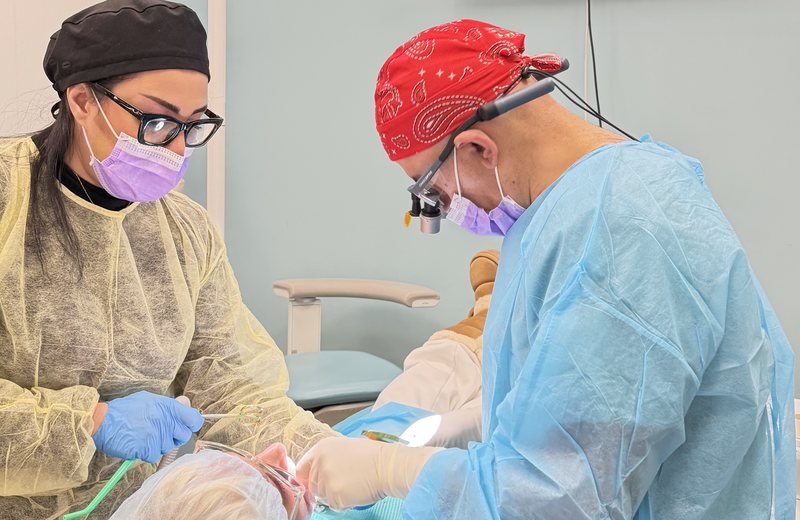
- Graft Material Placement and Membrane Sealing: Our clinicians carefully clear the target site and place the bone matrix material. The graft is then overlaid with a protective, specialized collagen membrane to block fast-growing gum tissues from invading the space, allowing the slower-growing bone cells to regenerate safely. This precise isolation protocol matches the surgical guidelines supported by the Ontario Dental Association (ODA).
- Dissolvable Sutured Closure: The gum tissue is closed smoothly over the graft site using soft, dissolvable sutures to protect the initial healing matrix from food particles or oral bacteria.
Direct Patient Decision Support: Rebuilding Bone vs. Leaving a Gap
To help you understand why preserving jawbone density is vital for your long-term oral health and future tooth replacement options, review our clinical comparison guide below:
| Feature | Proactive Bone Grafting Surgery | Leaving an Empty Extraction Gap |
|---|---|---|
| Jawbone Structural Volume | Actively preserves and increases bone height and width. | Experiences gradual, permanent bone resorption and shrinking. |
| Dental Implant Eligibility | Ensures adequate bone density to anchor an implant post safely. | Often makes dental implant placement impossible without major future surgery. |
| Facial Profile Stability | Maintains natural structural support for your lips and cheeks. | Can lead to a sunken facial appearance over time due to localized bone loss. |
| Average Initial Healing | The initial surgical site heals comfortably within 7 to 14 days. | The surface gums close, but the underlying bone volume continues to drop. |
| Total Bone Consolidation | Takes 3 to 6 months to solidify into mature, natural bone. | Bone volume continues to thin progressively year after year. |
Actively preserves and increases bone height and width.
Experiences gradual, permanent bone resorption and shrinking.
Ensures adequate bone density to anchor an implant post safely.
Often makes dental implant placement impossible without major future surgery.
Maintains natural structural support for your lips and cheeks.
Can lead to a sunken facial appearance over time due to localized bone loss.
The initial surgical site heals comfortably within 7 to 14 days.
The surface gums close, but the underlying bone volume continues to drop.
Takes 3 to 6 months to solidify into mature, natural bone.
Bone volume continues to thin progressively year after year.
Clear Financial Guidance: Oral Surgery Benefits and the CDCP
We believe that planning advanced oral surgery should never involve unexpected administrative boundaries. The positive news is that when bone grafting is performed as a therapeutic necessity to repair a structural jaw defect or as part of an authorized major restorative plan, partial or substantial coverage may be available under specific private dental insurance policies. To help your family navigate the financial aspects of care smoothly, our front office provides the following direct support:
- Comprehensive Surgical Pre-Determinations: Our billing team compiles your 3D digital scans, diagnostic notes, and specific anatomical codes into a detailed pre-determination form, submitting it instantly to your insurer so you know your exact eligible benefits before your surgery date.
- The Canadian Dental Care Plan (CDCP) Policy Scope: It is important to note that public safety-net frameworks like the CDCP operate under highly restrictive guidelines regarding specialized oral surgery. Routine bone grafting for elective dental implants is generally not a basic covered benefit under the CDCP. Our team manages all administrative routing in full compliance with the federal frameworks supported by the Canadian Dental Association (CDA) to help you clarify alternative structural benefits.
Frequently Asked Questions
Is a dental bone grafting procedure painful?
No. Our clinical team prioritizes your physical comfort, utilizing advanced local numbing techniques to ensure you feel absolutely zero sharp pain during the placement of the graft material. After your appointment, it is completely normal to notice mild, temporary gum swelling, minor bruising, or a dull ache around the surgical site for three to five days, which is easily managed with standard over-the-counter care.
How long does it take for a bone graft to completely heal and mature?
While the soft surface gum tissues heal comfortably within a week or two, the underlying bone grafting material takes anywhere from three to six months to fully fuse, solidify, and integrate with your natural jawbone structure. Once this cellular consolidation phase is complete, the site will be strong enough to hold a dental implant post permanently.
What are the main rules I need to follow at home after my bone graft?
To ensure your bone graft heals predictably, you must avoid brushing directly over the active sutures for the first week, rinsing with a gentle prescribed anti-bacterial mouthwash instead. Do not chew hard or crunchy foods directly on the surgical side, and refrain from creating suction in your mouth—such as smoking or drinking through a straw—as this can dislodge the graft material before it stabilizes.
Schedule Your Structural Bone Grafting Evaluation in Bradford
Leaving an empty extraction site unpreserved allows your underlying jawbone to resorb and shrink continuously, permanently eliminating the strong bone volume required to support a stable dental implant later. Contact Hola Dentistry today to secure your technology-driven bone grafting consultation in a professional, highly modern environment.