
An ache at the very back of your mouth — behind your last molar, in the jaw, sometimes spreading toward your ear — often turns out to involve a wisdom tooth. But pain on its own doesn’t tell you much. A sore wisdom tooth is not automatically a tooth that has to come out, and a quiet one is not automatically fine. What the pain means depends on what is actually happening under the gum, and only an examination and an X-ray can show that.
This guide explains the common reasons wisdom teeth start to hurt, the signs that mean it’s time to book an assessment, and the symptoms that should be seen promptly. If you are mainly wondering what removal itself involves, our page on wisdom tooth removal at Hola Dentistry covers the assessment, the procedure and aftercare in detail.
Table of Contents
- Why do wisdom teeth start to hurt?
- Signs it’s time to book an assessment
- Red flags: symptoms that shouldn’t wait
- What happens at a wisdom tooth assessment
- If removal is recommended: what to expect
- Frequently asked questions
Why Do Wisdom Teeth Start to Hurt?
Wisdom teeth are the third molars — the last teeth to arrive, usually sometime between the late teens and the mid-twenties. By then, the jaw is often already full, which is why these teeth cause more than their share of trouble. The most common reasons they ache are:
Coming through the gum (eruption). A tooth pushing through the gum can make the area tender and sore for a few days at a time. This kind of ache often comes and goes as the tooth slowly emerges, and on its own it is not a sign that anything is wrong.
A gum flap infection (pericoronitis). When a wisdom tooth only partly emerges, a flap of gum can remain over part of it. Food and bacteria collect underneath that flap, where a toothbrush can’t reach, and the gum becomes swollen, sore and sometimes infected. Pericoronitis is one of the most common causes of wisdom tooth pain, and it tends to come back until the underlying situation is dealt with.
Pressure from a crowded or angled tooth. Some wisdom teeth grow in sideways or tilted against the tooth in front of them and never fully emerge. That pressure can produce a dull, persistent jaw ache — and a tilted tooth can also damage its neighbour over time.
Decay in a hard-to-clean spot. Partly emerged wisdom teeth are difficult to brush and floss properly, so they decay more easily — and so does the back of the molar in front of them. Decay in either tooth can cause sensitivity, pain when biting, or a lingering ache.
Cysts and other hidden problems. Occasionally, a fluid-filled sac (a cyst) forms around an unerupted wisdom tooth. Cysts usually cause no pain at first and are typically found on an X-ray — one of the reasons an ache that keeps coming back is worth imaging rather than guessing about.
One caution: not every pain at the back of the mouth is a wisdom tooth. Jaw joint problems, sinus pressure (for upper teeth), a cracked molar and gum disease can all feel similar. Assuming the cause — in either direction — is how problems get missed.
Signs It’s Time to Book an Assessment
A single mild ache that settles within a few days may simply be a tooth erupting, and it is reasonable to watch it. The pattern matters more than any one episode. Book an assessment if you notice any of the following:
- Gum swelling or tenderness behind your last molar that keeps coming back
- Redness or a flap of gum over a partly visible back tooth
- A bad taste in your mouth, or bad breath that doesn’t clear with brushing
- Jaw stiffness, or soreness when you open wide or chew at the back
- Pain that spreads toward your ear, temple or along your jaw
- Food constantly getting trapped behind the last tooth
- A wisdom tooth that has been “coming in” for months without fully emerging
- Sensitivity or pain when biting on the molar in front of the wisdom tooth
None of these signs means a tooth definitely has to be removed. They mean the situation should be looked at properly, because the right response might be anything from simple monitoring to treating an infection to planning a removal — and those are very different plans.
Red Flags: Symptoms That Shouldn’t Wait
Some symptoms suggest an infection that is spreading, and those should be seen the same day:
- Swelling of the face, cheek or jaw
- Fever along with tooth or gum pain
- Increasing difficulty opening your mouth
- Trouble swallowing, or swelling that is spreading toward your neck
- Pain that is rapidly getting worse rather than easing
Hola Dentistry holds same-day emergency appointment slots on the days we are open — Monday to Friday, 10:00 a.m. to 5:00 p.m., and Saturday, 11:00 a.m. to 5:00 p.m. If you have swelling, fever or trouble opening your mouth during those hours, call us at (905) 551-0055 and tell us what you’re experiencing; our page on emergency dental care explains what to do first. If you ever have difficulty breathing or cannot swallow, that is a medical emergency — call 911 or go to the nearest hospital emergency department.
What Happens at a Wisdom Tooth Assessment
An assessment is a look, a picture, and a conversation — nothing is removed at a first visit unless you have agreed to a plan. At Hola Dentistry, an assessment for wisdom tooth pain generally involves:
A conversation and an examination. Your dentist will ask when the pain started, whether it comes and goes or is constant, and whether it has happened before, then examine the back teeth and gums to check for swelling, infection, decay and how far the tooth has emerged.
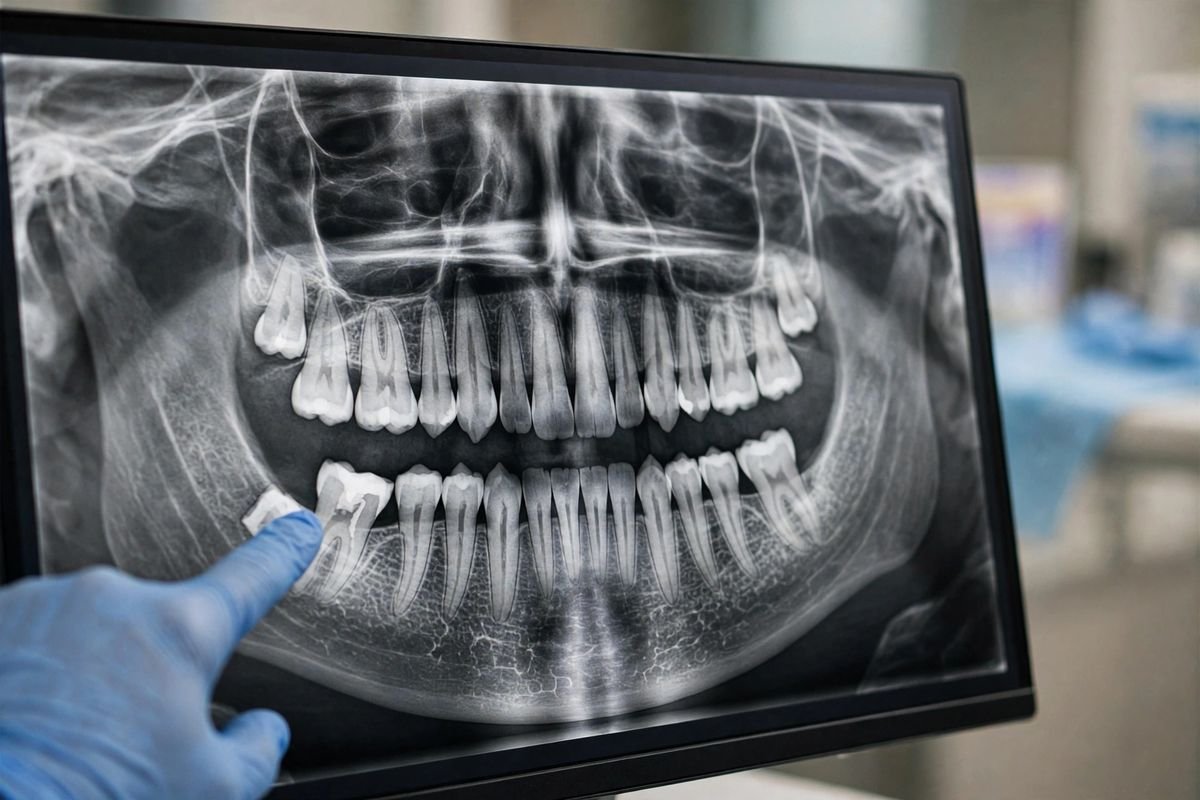
An X-ray. This is the step that actually answers the question. An X-ray shows whether the tooth is upright or angled, how its roots are shaped, how close it sits to the nerve in the lower jaw or the sinus in the upper jaw, and whether there are hidden problems such as decay in the neighbouring tooth or a cyst. Treatment advice without that picture is guesswork.
A recommendation with options. Depending on what the examination and X-ray show, the honest options are usually one of three:
- Monitor it. Many wisdom teeth never need to come out. If a tooth is healthy, well positioned and can be kept clean, the right plan is often simply to watch it at your regular checkups.
- Treat the immediate problem. If the pain is from an irritated or infected gum flap, treating that problem may settle things for now, while you decide about longer-term plans.
- Plan a removal. If the tooth is impacted, repeatedly infected, decayed, damaging its neighbour, or very unlikely to ever come in properly, your dentist may recommend removal — and explain why, what it involves, and what timing makes sense. Some complex cases are best handled by a specialist, and if that applies to you, we will say so and arrange a referral.
Dentists in Ontario are regulated by the Royal College of Dental Surgeons of Ontario, and a proper assessment before any recommendation is the standard you should expect — including being told when removal is not needed.
If Removal Is Recommended: What to Expect
If assessment shows that a wisdom tooth should come out, removal is a planned appointment, not a surprise. The area is frozen so the tooth can be removed as comfortably as possible, and you will be given aftercare instructions before you leave — rest, soft foods, and how to keep the area clean while it heals. Recovery varies: many people have a few days of swelling and soreness, and straightforward removals generally heal faster than deeply impacted ones. Your dentist will give you a realistic picture for your specific tooth rather than a generic promise.
The full details — how the procedure works, healing timelines and aftercare — are on our wisdom tooth removal page. What matters at this stage is simpler: pain is a signal to get information, not a verdict. Book an assessment, see the X-ray, and decide with the facts in front of you. You can book an appointment online or call Hola Dentistry at (905) 551-0055. We’re at 152 Holland St E in Bradford, open Monday to Friday, 10:00 a.m. to 5:00 p.m., and Saturday, 11:00 a.m. to 5:00 p.m.
For general patient information on oral health, the Ontario Dental Association and the Canadian Dental Association both publish free resources for patients.
Frequently asked questions
No. Pain can come from a tooth erupting, an irritated gum flap, decay, or pressure — and several of those do not require removal. Many wisdom teeth are simply monitored at regular checkups. Only an examination and an X-ray can show whether a particular tooth needs to come out, be treated, or be left alone.
Pericoronitis is inflammation or infection of the gum flap that partly covers a wisdom tooth that has’t fully emerged. Food and bacteria get trapped under the flap, causing swelling, soreness and sometimes a bad taste. It is one of the most common causes of wisdom tooth pain, and it tends to recur until the situation underneath is addressed.
Wisdom teeth often erupt in stages, so soreness can flare while the tooth is actively pushing through and settle in between. Gum flap infections also flare and calm down repeatedly. A pattern of pain that keeps returning is a sign to have the tooth assessed rather than something to simply live with.
Yes — pain from a back tooth can be felt in the jaw, temple or ear, because these areas share nerve pathways. But jaw joints, sinuses and other teeth can cause similar pain, which is why an examination matters: the source has to be identified before it can be treated.
Facial or jaw swelling, fever, difficulty opening your mouth, or trouble swallowing all call for same-day attention. Hola Dentistry holds same-day emergency slots on the days we are open (Monday–Friday 10–5, Saturday 11–5). If you cannot swallow or have difficulty breathing, call 911 or go to a hospital emergency department.
Your dentist will examine the teeth and gums at the back of your mouth and take an X-ray to see the tooth’s position, roots and any hidden problems. Then you’ll discuss the options honestly — monitoring, treating an immediate problem such as a gum infection, or planning a removal. Nothing is removed at an assessment visit without your agreement.
Sometimes, yes — a mild ache from a tooth erupting often settles on its own. But waiting is not a good plan if the pain keeps returning, the gum keeps swelling, or you notice a bad taste, spreading pain or difficulty opening your mouth. Those patterns usually mean the underlying problem is still there.
Most often in the late teens and twenties, when the teeth are coming in — but problems can appear at any age. A tooth that sat quietly for years can become infected or decayed later, especially because partly emerged wisdom teeth are hard to keep clean.
Coverage depends on your eligibility and the specific treatment, and it is assessed under the Canadian Dental Care Plan’s rules before treatment — our team can help you check what applies to you. Our earlier guide on CDCP and wisdom teeth explains the coverage side in detail; this post focuses on the symptoms themselves.